
Start a Dallas County Property Search
Start with whatever fact you already hold. An address works best in Dallas County Citizen Access. That portal is the county's system, also known as CaptureCAMA. An owner name can pull up every account under that spelling. A parcel or key number is the cleanest route to one exact account. Results tie together the situs address, owner of record, mailing address, and parcel identifier. You also see land and improvement values, exemptions, and tax fields. Remember that a situs address is the place being taxed. It may differ from where the owner gets mail.
Treat the assessment roll as a starting point, not proof of title. Dallas County deeds live with the Judge of Probate Recording Office. Parcel shapes sit in a separate GIS system. A sound property search moves from the broad roll toward the source that answers your exact question.
- Run an address, owner, parcel or key-number search in CaptureCAMA and note the parcel number.
- Compare the listed owner with the newest recorded deed at the Probate Recording Office.
- Read value, exemption and tax fields for the correct record year.
- Open the county GIS and match the parcel number, legal description and deed reference.
- Ask the custodian for a copy when an image or older item is not online.
Offices Behind Dallas County Records
Dallas County property records are divided by function rather than kept in one place. The Judge of Probate records real-estate instruments. The office also maintains them permanently. The Tax Assessor, with Mapping and Appraisal staff, looks after ownership, classification and value data. The Tax Collector holds the collection records. All of these services are based at the county courthouse complex in Selma. Check the county office directory before visiting. Public service hours can change.
Judge of Probate Recording Office
105 Lauderdale Street
Selma, AL 36701
334-874-2516
CaptureCAMA Search Choices
CaptureCAMA serves as the county's assessment and collection gateway. Its real-property search covers record years 2020 through 2026. The year control matters, because names, exemptions and values shift over time. Search modes are separate buttons rather than one free-form box.
| Search choice | Best input | Useful result |
|---|---|---|
| Property Address | Street number and name | Situs-linked parcel |
| Mailing Address | Owner mail destination | Accounts sharing that address |
| Owner | Person or entity name | Matching owner records |
| Parcel # | County parcel identifier | One mapped tax parcel |
| Key # | CaptureCAMA account key | Direct account match |
The portal is free to inspect. Each result carries identifiers you can reuse in the GIS and at the recording counter. If a full spelling comes up empty, try a shorter owner name or street stem, then confirm the chosen parcel by its situs and legal description.
The official CaptureCAMA search displays Dallas County's live lookup choices.
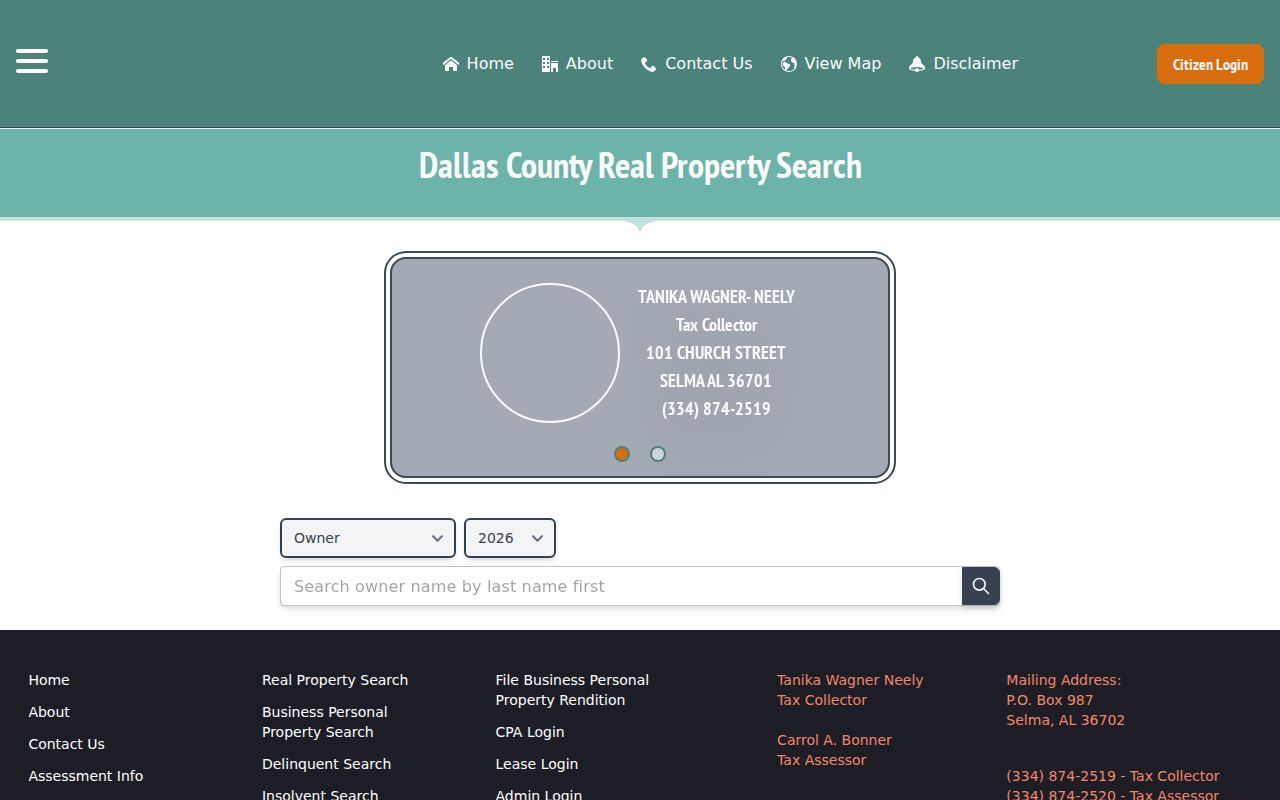
Separate buttons for address, mail address, owner, parcel and key searches make the starting input explicit.
Dallas County Deeds Stay Offline
The official county recording pages publish no online name or address deed index. The Recording Office instead offers public computer stations for viewing records. Military discharges and marriage licenses are excluded. Its permanent holdings include deeds, mortgages, liens, judgments, and plats. They also include powers of attorney, incorporations, and UCC filings.
The fallback chain starts with any known deed book and page. That reference may come from a GIS card or another record. Staff can verify limited facts by phone when given that reference. A visitor can also use the office terminal. Copies may sometimes go out by email or regular mail. A narrow request is far easier to fulfill than an open-ended title search. It should name the parcel, parties, document type, and date range.
Counter advantage. The courthouse stations are the public search channel when a Dallas County deed cannot be found through web tools.
Dallas County Property Record Sets
No single file tells the full story of Dallas County land. Deeds document recorded transfers. Mortgages, liens and judgments show claims placed in the public record. The assessment roll identifies the tax owner and the county's values. Tax collection records show amounts owed and any delinquency. Plats and parcel maps add spatial context. Probate and court files may explain a transfer that was not a routine sale.
| Record Type | What It Documents | Kept By | Access |
|---|---|---|---|
| Deeds | Recorded ownership transfers | Judge of Probate | Office terminal and copies |
| Mortgages and liens | Recorded claims and security instruments | Judge of Probate | Office terminal and copies |
| Tax and assessment | Owner, value, class, exemptions and tax | Assessor and Collector | Free CaptureCAMA portal |
| Plats and parcels | Lot layout and mapped parcel context | Probate and Mapping | Office records and free GIS |
| Court and estate files | Litigation or probate affecting property | Circuit Clerk or Probate | Clerk and court access |
Use the Dallas County deed records route for recorded ownership evidence. A map or assessment entry can point toward the right deed, but neither replaces the deed itself. Tax status belongs with the Collector, while a boundary claim calls for the plat, the legal description and a licensed survey.
Dallas County Deed Update Rhythm
A new deed and the assessment roll do not move in lockstep. The Dallas County GIS Deed Status Report states that deeds are posted online weekly. CAMA change forms are processed monthly. County assessment guidance also notes that Alabama property taxes are billed in arrears. The billing uses the owner of record on October 1 of the prior year. A recent buyer may therefore hold the newest recorded deed. Meanwhile the tax roll still shows the prior owner.
For a pending purchase, estate matter or deed-fraud concern, record dates decide which source deserves more weight. Check the current CaptureCAMA year. Note any deed book and page. Confirm the newest instrument with the Recording Office. The county publishes no fixed number of days from recording to roll update. The actual records should control.
Values in Dallas County Records
Alabama uses several distinct value terms. Appraised value is the county's estimate of fair market value. Assessed value is the taxable base after the classification percentage is applied. State law sets Class I at 30 percent. Class II sits at 20 percent and Class III at 10 percent. Exemptions and current-use treatment can change the taxable result. So the biggest number on a card is not always the figure behind the tax bill.
- Appraised value
- The assessor's full fair-market estimate.
- Assessed value
- Appraised value multiplied by the statutory class rate.
- Parcel
- A mapped unit of land carrying a county identifier.
- Plat
- A recorded drawing that lays out lots, blocks or a subdivision.
One Dallas County sample parcel, 101 Church, carried a market value of $2,380,000 and an assessed value of $476,000. The math is the point. That 20 percent ratio is the Class II formula at work, not a value estimate for any other parcel.
Dallas County GIS Runs Deeper
Dallas County Public GIS sits apart from CaptureCAMA. Its parcel search, branded for 2025, goes well past a simple address box. You can filter by parcel range, owner, situs address, mailing address, acreage, value, subdivision, district, deed book and page, deed date, and section-township-range. That depth rescues property searches that stall elsewhere. When an address fails, these fields give you other ways in.
A record card in the GIS can carry the parcel number, owner of record, mailing address, legal description, deed reference, acreage, building traits, appraised value, and annual tax bill. Treat the map as orientation only. It is not a surveyed boundary. The lines help you spot a likely parcel and its neighbors, yet a licensed survey and the recorded legal description settle any real dispute.
The official Dallas County GIS displayed below is the live map environment itself.
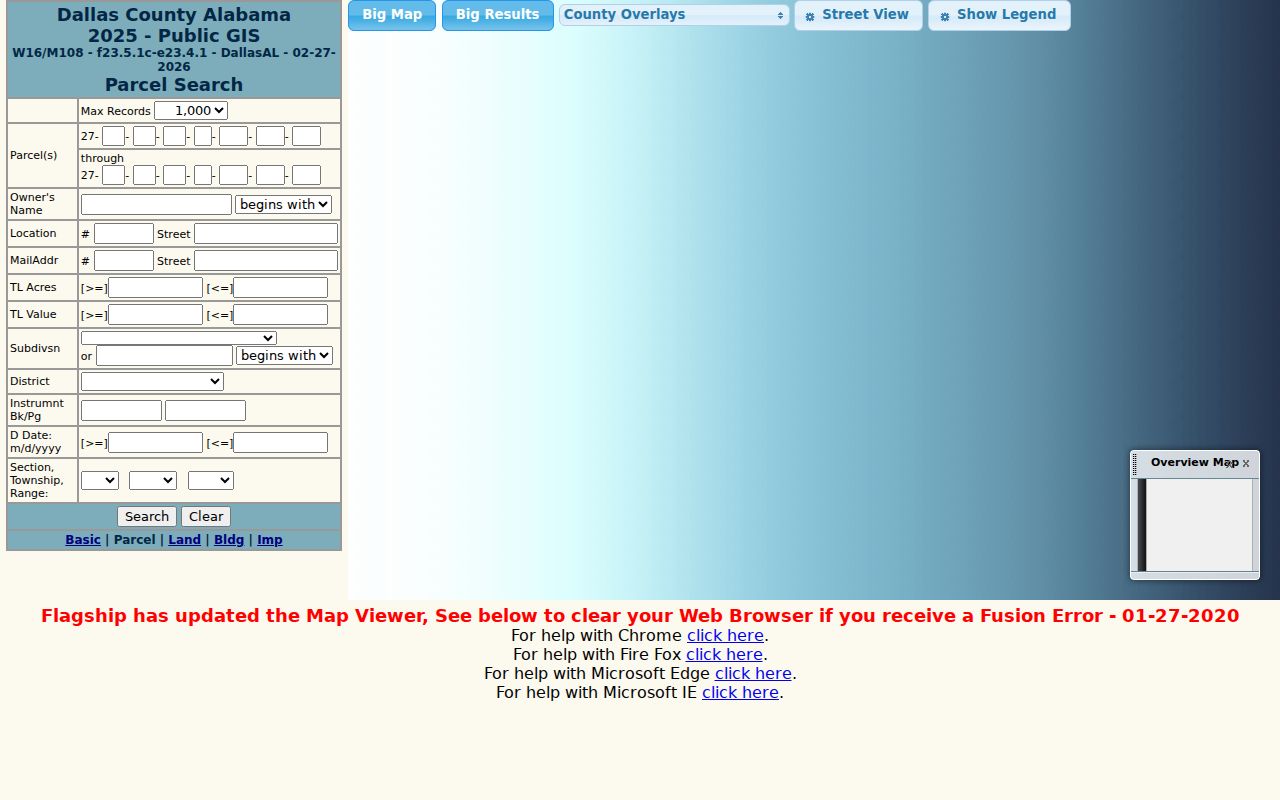
The map viewer supplies context while its linked record cards hold the searchable account facts for each parcel.
Dallas County Tax Delinquency Trail
CaptureCAMA also runs a separate delinquent-property search. Owner, address, and parcel inputs all work there. Delinquency can push a tax account toward lien sale and redemption. Alabama law attaches its own notices and dates to those steps. Before acting on a screen result, confirm any live balance with the Tax Collector.
Alabama Code sections 40-10-182 and 40-10-184 set the state's notice and bidding framework. It governs tax-lien sales. Dallas County collection material spans arrears, escrow, delinquency, sale, and redemption. A deed search remains essential. A tax account tells you assessment and collection status, not every interest in the title.
Selma Archives Add Address History
Current databases are only part of the property story. The Godbold Local History Room at the Selma-Dallas County Public Library keeps maps, genealogy sources, periodicals, census material, and photographs. Its research service sets limits on requests and sends complex work to the Alabama Department of Archives and History. The state archives also hosts a digital Selma Public Library collection of photographs and postcards.
Historic city directories fill gaps that deed records leave open. The Alabama Archives finding aid lists Selma directories for 1880-1881, 1904, 1913-1917, 1920-1921, 1939, many years from 1945 through 1987, and 1999 and 2001. A directory can tie a name or street to a year. It does not prove ownership. Even so, it can supply the date range you need before diving into deed books.
Dallas County Record Requests
Alabama law, in Code section 36-12-40, gives citizens the right to inspect and copy public writings. Some exceptions apply. A Dallas County property record may not be available online. The request then goes to the office that keeps it. Identify the property, parcel, or book and page. Describe the exact record you need. Give a date range. State whether you want to view it, get a plain copy, or order a certified copy.
This is not a title-search service. Recording staff can show you the public station. They can confirm limited facts from a reference you supply. They can also explain copy options. Court files belong to the Dallas County Circuit Clerk. Statewide Alacourt access is read-only and requires a subscription. AlaFile handles electronic filing and service copies rather than serving as a free property index.
Limits of Dallas County Property Records
Dallas County property records answer many questions. They can name the tax owner and show a recorded transfer. They can list county values and reveal recorded liens. They can also place a parcel on a public map. Clear title is not among their promises. Unrecorded claims can still exist. An estate or court case may affect rights that no single parcel card reveals. An LLC or trust may stand in for a person. A mailing address can point far from the land itself.
These records also cannot settle a legal boundary or predict a sale price. For title assurance, use a title professional. A licensed surveyor handles boundary work, and an appraiser gives a current value opinion. Public access still supports purchase due diligence and estate research. It supports tax review, house history, and civic transparency.
Lawful use. Check the newest deed, correct assessment year and matching parcel. Never use owner information to stalk, harass or harm anyone.
Probate Transfers in Dallas County
Not every ownership change starts with a deed from a seller. A death can push the search into a will. It may also point to an estate file, a conservatorship record, or a later deed signed by heirs or a personal representative. Dallas County's probate judge wears two hats here. The office records land instruments and also handles probate matters, though the two produce separate record sets. The Wills and Estates office explains filing and estate administration. It also covers the rules for wills held more than five years and for estate inventories. One deed card may not tell you why an estate appears in the chain of title. It may not explain several heirs there either.
Work backward from the assessment roll.
Begin with the last owner of record and the most recent deed reference. If that owner died, locate the estate file and read the order granting someone authority to act. Then go back to Recording and Records. Look there for any deed that moved the parcel out of the estate. A death certificate can help with identity and dates. But the Alabama Department of Public Health restricts death certificates for 25 years. Only certain people may obtain one during that window.
Estate research runs on two clocks. Probate papers establish who held authority and how the estate was administered. Recorded deeds show what actually reached the land record. Keep case numbers, deed book and page, the parcel number, names, and dates in one place. An estate file may name land but no later deed appears. Ask the Probate Office which record series comes next at that point. Never assume an heir owns a parcel just because a will names them. Administration, debts, later conveyances, and the recorded chain can all change the outcome.
Dallas County Records Through Time
Dallas County property records stretch from bound deed and plat volumes to weekly deed-status reports. They also live in modern parcel databases. That shift did not put every old image online. Earlier ownership work may still call for the Recording Office station or the deed books. It may also call for the local history room or the state archives. A failed web search does not mean the record is missing.
The modern parcel number works as a bridge. It links CaptureCAMA to GIS data and often to a deed book and page. The recorded instrument then names the grantor and grantee. You need those names to work backward through Dallas County deed records. Historic maps, directories, and photographs add context once the chain is known. Each source answers one narrow question. Together, they build a reliable Dallas County property record.