
What Dallas County Deed Records Convey
A deed does several jobs at once. It names the parties. It describes the land. It also states the form of conveyance and carries a recording reference. What the document actually accomplishes depends on its wording. The chain of title around it matters just as much. The Dallas County Recording Office files far more than deeds. Mortgages, liens, judgments, plats, powers of attorney, incorporations, and UCC filings all pass through the same counter. They are distinct instruments rather than deeds by another name.
| Deed Type | What It Does | Common Use |
|---|---|---|
| Warranty deed | Conveys the stated estate with warranties written in the instrument | Ordinary purchase |
| Quitclaim deed | Conveys whatever interest the grantor may have | Family or chain cleanup |
| Executor or administrator deed | Conveys under estate authority | Probate property transfer |
| Foreclosure deed | Records a conveyance following foreclosure authority | Distressed-property chain |
| Tax deed | Follows statutory tax-sale and redemption procedures | Delinquent-tax chain |
A mortgage secures a debt. A release can discharge it. Liens and judgments, meanwhile, can encumber an interest without ever changing the owner of record. That is why a deed alone rarely tells the whole story of a title. Read every referenced instrument before assuming the parcel is clear.
Dallas County Deed Index Access
The Judge of Probate Recording Office at 105 Lauderdale Street keeps the county's permanent real-estate records. It also offers public computer stations for searching them. Its official page publishes no browser-based deed index. It states no starting year for online records. Visitors run their own searches on site. Staff will verify limited details by phone, but only when the caller can supply a book and page. The e-recording links for Simplifile and CSC are submission channels for filers, not deed-search tools. So locating a parcel online does not mean its deed image is there too. Copies can sometimes be sent by email to recording@dallascounty-al.org or by mail at P.O. Box 987, Selma, AL 36702-0987.
Note: The county page lists a 4:30 a.m. closing time while other county pages show 4:30 p.m., so call 334-877-0625 before visiting.
Walk the Dallas County Grantor-Grantee Chain
Start with the deed book and page. Add the legal description on the CAMA or GIS card. Pull that instrument at Probate. Before treating its parties as a link in the chain, confirm the parcel description matches the land being researched. A mismatched description can send a title search down the wrong branch of the deed records.
- Open the current deed and record its grantee, grantor, date, book/page, and full land description.
- Use the grantor as the next historical person or entity to search as a grantee.
- Compare acreage, lot/block, subdivision, roads, and section-township-range at every link.
- Follow prior-instrument recitals and repeat through older deed books and indexes.
- Grantor
- The party conveying the stated interest.
- Grantee
- The party receiving the stated interest.
- Chain of title
- The linked sequence of instruments affecting the same land.
- Book/page
- Dallas County's compact reference for retrieving a recorded document.
Carry Dallas County Book and Page
Dallas County property cards show how book-and-page references work in practice. A current CAMA card for a Church Street sample displays Book 001614, Page 000632, with legal remarks citing earlier references at DB 1321 PG 118 and DB 1482 PG 304. A legacy rural card shows B/P 001432-000040 with legal text at DB 1432 PG 36–40. References like these make a targeted copy request possible even without a web index. The official GIS property-record card appears below.
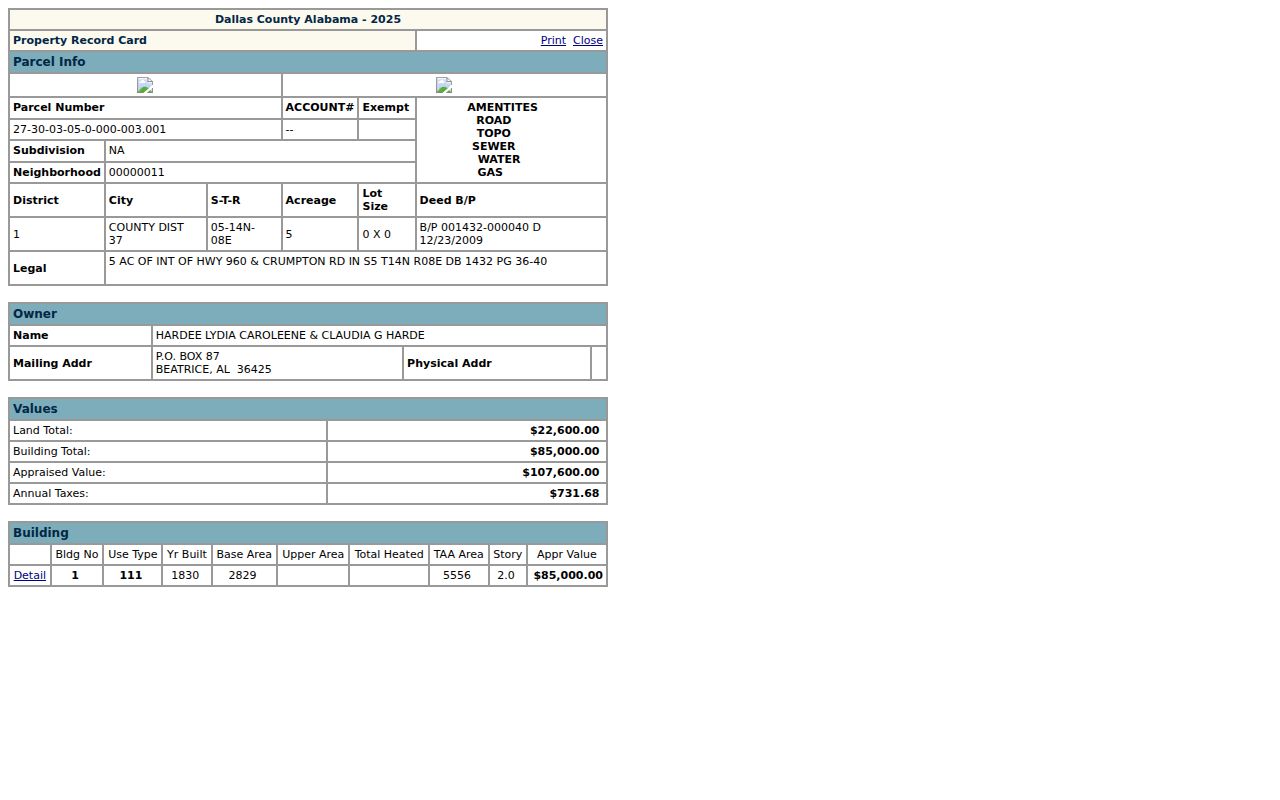
Treat the deed reference and legal description on an assessment card as retrieval clues. A linked image there should not be called a deed image until its target is confirmed.
Dallas County Deeds and Plats
A recorded plat can reveal what a street address never will. Subdivision name, lot and block, roads, easements, and boundary context all live in the plat books. One Selma annexation petition cites Martindale Addition Plat Number 2 in Dallas County Map Book 5, Page 301. That municipal filing points back to county plat records rather than replacing them. For older or rural land, compare bearings and distances, road names, adjacent owners, acreage, and the section-township-range. A modern postal label or map pin may not reproduce the land identity. The recorded description holds that identity instead.
Dallas County Deed Posting Schedule
The Dallas Deed Status Report lays out the posting rhythm. New deeds go online Monday when recorded before Thursday noon of the prior week. Previous-month change forms are printed in the second week. They are then sent to the county for CAMA entry. A current deed and the assessor's owner field can therefore disagree for a stretch. The report itself covers deeds recorded October 1, 2025 through September 30, 2026. That range applies to tax year 2027. It documents maintenance timing only. It is not a public grantor-grantee search. Nor is it a guaranteed update interval for any one parcel.
Dallas County Historic Deed Books
The county publishes no verified earliest deed-book year. There is no public online cutoff either. So when a current card runs dry, keep going at the office terminals. Ask about older deed books, plat books, and indexes. The Godbold Local History Department holds maps, indexes, directories, rare books, and local-history materials that can translate an old address or owner name. None of it establishes title, though. Historic directories and maps work best when paired with deed-recital clues. Record the spelling variants and date ranges you find. Then return to Probate for the instrument tied to the same legal description.
Request a Dallas County Deed Copy
In person, use the Recording Office computer stations. Military discharges and marriage licenses sit outside that general terminal access. For remote retrieval, supply the exact book and page, the parties, the record type, the date if known, and the parcel or address. Also state the format you want. Ask whether the image can be emailed or mailed. Confirm payment, per-page, and certification charges before ordering. The official recording-fee page links the current schedule. It does not spell out general copy and certification amounts for real-estate records. Originals or certified copies are required when submitting an instrument for recording. The county directs filers to redact Social Security numbers.
Recorded, not guaranteed. Dallas County deed records show what reached the public record; one deed is not a title opinion and does not prove that every lien, release, court order, or unrecorded claim has been resolved.
A strong request for a Dallas County deed copy starts with the basics: grantor, grantee, instrument type, and an approximate date. Add the book and page if known, plus the parcel number or street address and enough of the legal description to separate one tract from its neighbors. Say up front whether a working copy will do or a certified copy is required. The Recording Office page posts no standard turnaround, so ask staff for a current estimate when you submit. Planning the details first saves a second trip.
Entity grantees need extra care. Search the exact legal name and entity number through the Alabama Secretary of State, then return to the deed. Officer and agent listings can help tell two companies apart. They do not prove who owns a parcel. Estate transfers raise similar questions. A will, letters, sale order, or settlement may explain someone's authority, but the recorded conveyance is what moves the land. A death certificate confirms identity, not title. Work from the decedent's legal name, the probate case number if known, the parcel, and the deed reference. Follow every mortgage, assignment, satisfaction, lien, judgment, power of attorney, and court order that touches the chain. Check that each release matches the original parties and its reference. A newspaper notice is only a lead until the county record behind it has been read.
Track more than names at the terminals. A worksheet keeps the work honest. Give it columns for date, grantor, grantee, deed type, book and page, prior reference, legal-description match, and any unresolved instruments. That habit prevents two properties held by one party from blending into a single chain. Log every spelling variant too: initials, suffixes, former surnames, even entity punctuation. Probate or marriage papers can explain a name change. Still, tie the two names together with a deed recital, affidavit, order, or other official instrument before treating them as one link. Read the land description at every step. A grantor may have conveyed several Dallas County tracts at different times, and a shared surname proves nothing. Lot, block, subdivision, acreage, section-township-range, road calls, and prior deed references keep the chain tied to the right property. If a cited instrument cannot be found, note the gap plainly. Recording Office staff can say which older index or book series covers that date and instrument type. Library maps and directories serve only to suggest new spellings and location clues.
The legal description is the real continuity test. An urban deed leans on subdivision, lot, block, alleys, bearings, and earlier book and page citations. A rural deed rests on acreage, road calls, adjoining owners, and section-township-range. Compare the whole description each time. An owner may convey one part of a tract and keep the rest, and a shared street address does not mean two instruments cover identical land. Plats and restrictions deserve their own review. A deed can fold in a recorded plat or covenant by reference, so pull the cited map book, page, or restriction instrument rather than stopping at the conveyance. Easements may touch only part of a tract. A later vacation, amendment, release, or corrective deed can also change what an older reference means. Recording rules shape readable copies as well. Originals or certified copies are required for recording, and filers are told not to include Social Security numbers and to redact them. Do not repeat sensitive identifiers from an old instrument in shared notes. Ask the custodian about access limits instead of assuming every record at a terminal can be copied without qualification.