
Trace a Dallas County Property Owner
Work from place to parcel to person, then test that name against the recorded instrument. This order matters. It prevents mix-ups when two owners share a similar name or when the tax mailing address sits far from the land itself, so the parcel stays anchored to one true owner of record throughout the search.
- Enter the situs address in Dallas County Citizen Access / CaptureCAMA. If it fails, try the street name alone, owner name, parcel number, or key number.
- Save the owner, parcel and key/account numbers, municipality, legal description, deed book/page, and selected record year.
- Confirm a recent transfer through the Judge of Probate Recording Office, using its public terminal or a targeted book/page request.
- When the owner is an LLC or corporation, compare its exact name with the Alabama business-entity search; use the roll's mailing address for lawful property correspondence.
Rural land often has no street address at all. Turn instead to the Dallas County Public GIS, or start from a section-township-range description, a road reference, acreage, or a deed book and page. Keep the parcel identifier beside every note. Spaced and legacy hyphenated identifiers still coexist in Dallas County property records, so the exact form matters.
Read the CaptureCAMA Owner Field in Context
CaptureCAMA splits its display into Owner, Mailing Address, and Property Address. Each field answers a different question. The owner field is the tax roll's answer to who owns the parcel. Mailing shows where notices go. Property address marks the situs. A post-office box or out-of-town destination tells you nothing about where the owner lives. The occupant may go unnamed entirely. Dating matters too. The search offers record years 2020 through 2026. These are tax-record views, not the start of Dallas County deed history. Alabama bills property tax in arrears against the preceding October 1 roll. A newly sold parcel can still carry the former owner's tax name. The 101 Church parcel card shows where owner, mailing, situs, parcel, legal, and book/page fields sit together.
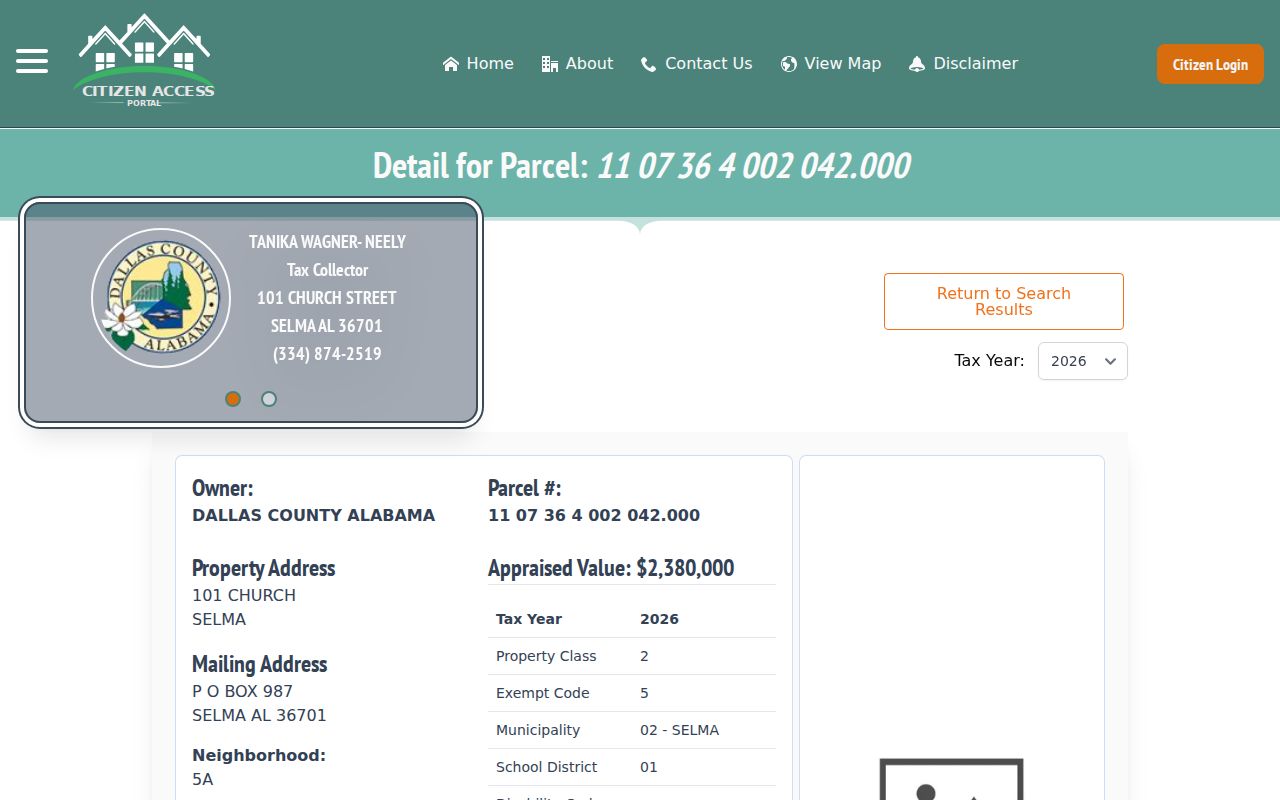
Treat that layout as a reading guide only, and never carry its sample name or figures over to another address.
Identify a Recent Dallas County Owner
A freshly recorded deed can outrun the tax roll. Dallas County deeds are posted online Mondays when they arrive before noon the prior Thursday, according to the Dallas Deed Status Report. Prior-month change forms go out for CAMA entry during the second week of each month. The county publishes no fixed number of days from recording to a changed owner field. Expect a gap. Check both deed records and the roll before concluding a parcel has not sold.
Timing check. For a recent closing, identify the grantee and recording date on the newest deed. Compare its legal description and book/page with the parcel card rather than assuming the tax name has changed.
The Recording Office at 105 Lauderdale Street in Selma keeps permanent deeds, mortgages, liens, judgments, and plats. It publishes no public web grantor or grantee index. Visitors can search at office computer stations. Given a book and page, staff can verify limited information by phone, and copies may sometimes go out by email or regular mail, so a deed-book reference speeds everything up.
Trace an LLC, Trust, or Estate Name
An LLC, trust, or estate on the Dallas County roll is still the owner of record. No manager may be named. Alabama business records can be searched by entity name. You can also search by number, officer, agent, incorporator, reservation, or registration ID. A registered agent is a contact point. That is not proof the agent owns the land personally.
Trustees and personal representatives need a closer read. The recorded deed should state the capacity of a trustee, executor, administrator, or estate representative. Probate files can explain an estate transfer. Still, the operative deed or order and the legal description must tie to the same parcel. Only then is the chain sound.
Match Dallas County Ownership Sources
No single screen settles every ownership question. The assessor offers the quickest identity lead, GIS fixes the name to a mapped parcel, and the latest deed documents the conveyance, so matching sources across offices is the dependable route.
| Local source | Ownership evidence | Access route |
|---|---|---|
| CaptureCAMA roll | Owner, mailing/situs addresses, parcel/key and year | Free web search |
| Probate Recording Office | Grantee, grantor, legal description and vesting | Terminal; book/page phone check; email/mail copy |
| Alabama Secretary of State | Entity identity and listed agent or officer | Public business search |
| Dallas Public GIS | Mapped parcel, owner and deed-reference clues | Free viewer and reports |
Sources can disagree because each serves a different purpose and updates on its own schedule. Check any conflict first. When parcel identity, legal description, or deed reference clashes, resolve the mismatch before attaching an owner name to the property.
Old Selma Addresses as Owner Clues
The Godbold Local History Room holds maps, directories, census material, photographs, and periodials. Those sources can turn an earlier owner or address into a modern parcel lead. Alabama Archives lists Selma directories at intervals from 1880 through 1881 up to 2001. These help when a deed names a road, lot, or building. It may no longer match a modern situs. A directory, though, identifies an occupant or business rather than proving ownership. Carry the clue forward to the legal description, map book, section-township-range, and the deed itself.
Complete the Dallas County Two-Office Check
- Save the CAMA year, exact owner spelling, parcel and key numbers.
- Distinguish situs from the owner's mailing destination.
- Compare the legal description and deed book/page.
- Ask Recording about the newest instrument when the sale is recent.
- Follow an entity or estate name only far enough to identify capacity.
The Dallas County property-search process covers the full portal mechanics for both offices. To reconstruct earlier ownership, continue with former property owners; for recorded proof, use Dallas County deed records.
Resolve a Dallas County Owner-Name Mismatch
Start with the parcel, not the name. Before treating a mismatch as a real conflict, confirm that CAMA, the GIS map, and the deed all describe the same property. It should be in Dallas County. Match the parcel number and key number. Also match the municipality, the acreage, and the lot and block or section-township-range detail. Compare the full legal description too. Two holdings can share one owner name. A near-identical street address can also point to an adjoining lot. Add the formatting trap: current CAMA uses a spaced parcel style. The legacy GIS view uses hyphens. So cross-check through account, key, and book/page fields.
Then put the evidence in order by date and function. A deed recorded after the roll date can legitimately name the new grantee. Meanwhile the tax roll still carries the October 1 owner of record. A quitclaim, correction, mortgage, lien, or release does not move title the way a warranty deed does. Read the instrument itself. Never assume every fresh book/page entry is a sale.
Estate, trust, and business owners need care as well. Record the capacity exactly as the deed records show it. Probate authority, an Alabama entity entry, or a registered-agent address can clarify who may act for the owner of record. None of these replaces the conveyance itself. For unresolved legal-description or vesting conflicts, contact the Recording Office. For high stakes, bring in qualified title help.
Reach Dallas County Ownership Records Offline
The search does not die when the website does. The Tax Assessor works from the Dallas County Administration Building at 101 Church Street in Selma. Hours are 8:30 a.m. to 4:30 p.m., Monday through Friday, at 334-874-2520. Mapping and Appraisal answers at 334-874-2535. Bring the address and the parcel or key number. Bring the owner spelling and the record year you already checked. That lets staff pinpoint the problem fast.
For deed records, the Recording Office sits at 105 Lauderdale Street in Selma. Call 334-877-0625, email recording@dallascounty-al.org, or mail P.O. Box 987, Selma, Alabama 36702-0987. The counter and computer-station route matters. The county publishes no public web grantor/grantee index for deed records. Fix the parcel identity first, and supply the book/page when you have it. Only then ask for the newest deed.
Alabama's public-records inspection statute supports a focused request for a public writing, subject to its exceptions. Describe the specific record you need. Do not ask the office to run an open-ended ownership investigation. Certified copies, title interpretation, and survey conclusions are separate services.
Dallas County Owner Lookup Limits
A public owner field has limits. It does not tell you who occupies a building. It does not reveal whether an unrecorded interest exists. It will not show whether every lien was released, or whether a boundary sits correctly. It is not a title examination, legal opinion, or survey. Trust and entity records can place a legal name between the parcel and the people involved. The actual owners may sit behind that name.
Alabama Code §36-12-40 grants a right to inspect and copy public writings, subject to exceptions. It does not erase confidentiality rules or authorize intrusive use. Verify decisive facts with the official custodian, such as the recorder or assessor.
A clean lookup result should be reproducible. Another searcher working from the same parcel, record year, owner spelling, and latest-deed reference should land on the same answer. Save enough detail to repeat the route. Skip collecting unrelated personal details. When a public field is blank, report it as blank. Do not guess from directories, social media, or nearby parcels.
Lawful use. Dallas County owner information is suitable for purchase diligence, boundary questions, estate work and house history. Never use an owner name or mailing address to stalk, harass, intimidate, or harm anyone.