
Compare the Dallas County Value Types
CaptureCAMA separates value stages rather than presenting a single universal property value.
| Figure | Meaning | Record source |
|---|---|---|
| Market / appraised | County mass-appraisal estimate before classification | Assessor parcel detail |
| Assessed | Appraised value multiplied by Alabama class ratio | Assessment roll |
| Taxable / net | Amount remaining after applicable exemptions or adjustments | Tax detail |
| Recorded sale evidence | Consideration and transfer facts reported with deed/RT-1 | Recording Office |
| Land / improvement | Components assigned to site and structures | Property card |
Assessment and sale price answer different questions. One comes from a valuation process the county runs; the other reflects what a single buyer actually paid in one transaction.
Understand Dallas County's 20 Percent Demonstration
A 101 Church parcel in Dallas County shows how the math works. Its market/final value stands at $2,380,000. Class II applies, so take 20 percent. That yields exactly $476,000, which matches the parcel's assessed value.
The official sample parcel detail puts those value fields alongside classification, exemption, tax, and parcel data. Treat it as a clean demonstration of the formula. It does not mean every Dallas County parcel carries that same ratio.
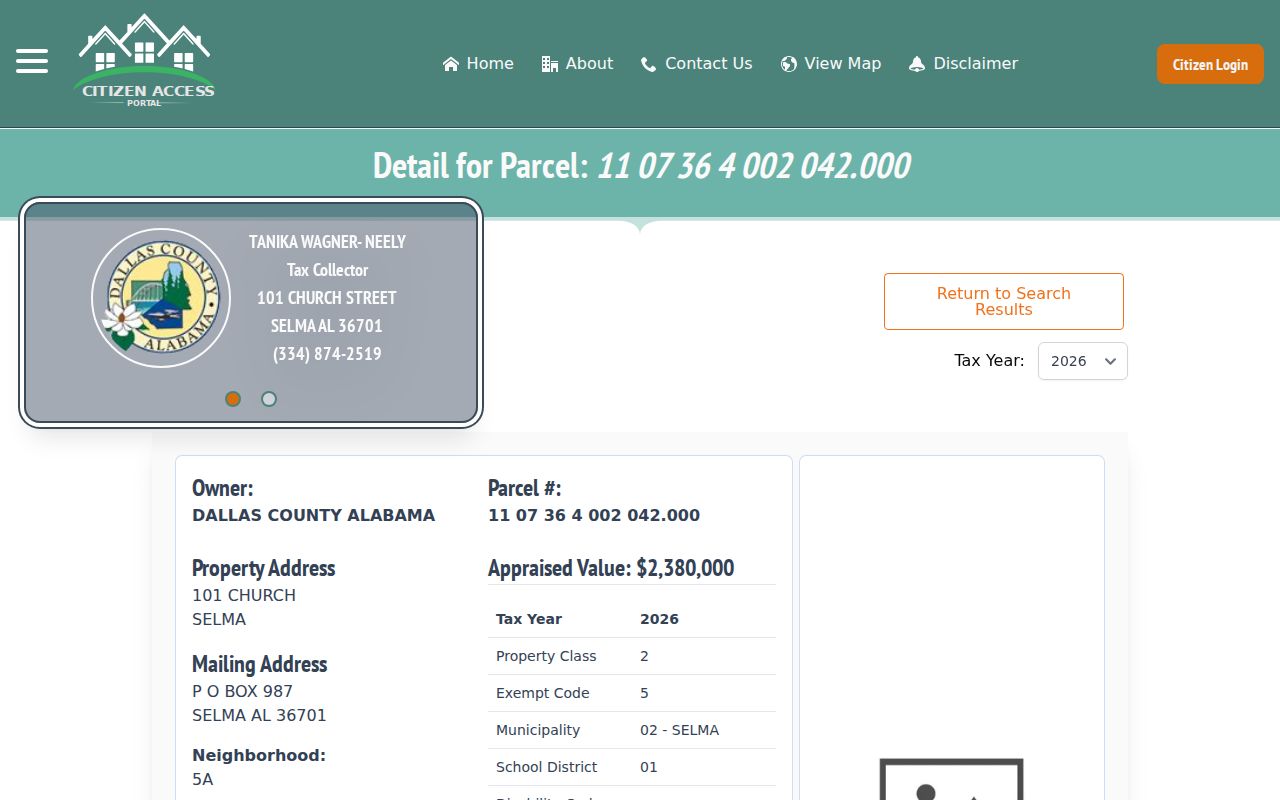
Always read the selected year and classification before reproducing the calculation for another property.
Apply Alabama Classification Before Comparing Values
Alabama's revenue department sets classification ratios. Class I sits at 30 percent and covers utility property. Class II sits at 20 percent and covers anything not otherwise classified. Class III sits at 10 percent. It includes qualifying owner-occupied residential, agricultural, forest, and historic property.
Two neighboring Dallas County parcels can hold similar market values. Their assessed values can still come out very differently. This is why classification or exemption status drives the gap. Compare market to market and assessed to assessed. Never mistake a lower assessed figure for a discount sale price.
- Appraised value
- The assessor's full-value estimate.
- Assessed value
- Appraised value after the statutory class ratio.
- Millage
- The rate applied for tax calculation, not a valuation method.
Estimate Dallas County Property Value
- Find the parcel in CaptureCAMA by address, parcel or key.
- Save the record year, class, exemption and land/improvement components.
- Compare Market, Appraised, Assessed and Taxable labels without merging them.
- Use the latest deed and RT-1 only for recorded sale evidence.
- If analyzing taxes, move to property tax records for exemption, appeal and bill procedure.
Label confusion trips up many Dallas County property records searches. The legacy GIS card may show a figure called "Appraised Value" plus annual taxes. The current CAMA system breaks things out differently. It lists Market, Appraised, Assessed, and Taxable values along with gross, exempt, and net tax. These are two system generations. Treat the labels accordingly, not as interchangeable terms.
Keep Recorded Sale Evidence Separate
Dallas County's RT-1 real-estate sales validation form records the grantor, the grantee, and the sale and value details. Together these cover a transfer. A deed plus that validation material documents the transaction. It does not by itself set the assessor's market value for the parcel.
The Appraisal Department relies on sales studies instead. Its guidance notes that foreclosure and short-sale transactions can involve undue stimulus. That matters when picking comparable evidence. One distressed transfer should never stand in for a neighborhood's ordinary property value.
Comparison rule. Date every number, identify its source and label it as assessment, taxable amount, sale evidence or professional opinion.
Current Use and the Seven Percent Cap
Qualifying Alabama Class III agricultural and forest land may be assessed on current-use value. Dallas County owners rely on Ala. Code §§40-7-25.1 and 40-7-25.2. The owner must ask for that treatment during the statutory filing window. A new owner may need to reapply. Acreage alone does not make a parcel qualify.
The state Department of Revenue also publishes guidance on the assessed-value increase cap. It applies under Act 2024-344. That framework sets a 7 percent cap with listed exceptions. Confirm the current tax year and official instructions before relying on it for any Dallas County property records calculation.
Separate Dallas Millage From Property Value
The county portal breaks out total millage by place. Rows list 34.1 for county/Valley Grande, 42.0 for Orrville, and 57.5 for Selma. Rates like these convert assessed value into a tax bill. They do not mean an identical property has a different market value. Location alone does not change what a house is worth.
Municipal code and location decide which rate applies. Confirm through the parcel record where the parcel lies. It may sit inside Selma, Valley Grande, Orrville, or a county district. Do not trust the postal city alone.
Compare Dallas County Values on Equal Terms
A useful comparison holds record year, value type, and property class constant. Put market or appraised value beside the same field on another parcel. Put assessed value beside assessed value. Note whether land and improvements are both included. Note whether an exemption or current-use treatment changes the taxable result. Skip those checks, and a mathematically correct comparison can still mislead.
Use neighborhood and aerial layers only to shortlist candidates. The public GIS publishes no professional comparable-sales opinion. Physical similarity seen from above says nothing about condition or interior differences. Review the recorded deed evidence and the appraisal treatment before calling any sale comparable.
Timing matters too. The CAMA search covers 2020–2026, while the legacy GIS report carries 2025 branding. A figure from one year should never be compared silently against another. Save the portal, field label, and date with each number.
Review Why a Dallas County Value Changed
Why did your Dallas County value move? The Appraisal Department points to reappraisal, sales studies, permits, and value notices as the moving pieces. A new appraisal cycle can shift the number. So can updated improvements, a classification change, a revised exemption, or a simple correction. None of that has to match what a property last sold for, so don't read a recent sale as the whole story.
Pull two consecutive record years and split the difference into its parts: land, improvements, market and appraised value, assessed value, and taxable value. That breakdown usually reveals where the change actually happened. Planning to challenge the figure? Keep the notice date. Alabama Code §40-7-25 sets a written-objection framework tied to that notice, and §40-3-25 governs appeal timing after a Board of Equalization decision. These steps sit inside the property tax records process, and they show exactly why a dated value record in Dallas County matters.
Verify Dallas County Value Records Offline
Start with CaptureCAMA, then take anything unresolved to the Tax Assessor at 101 Church Street in Selma, 334-874-2520, or Mapping and Appraisal at 334-874-2535. Offices keep weekday hours from 8:30 a.m. to 4:30 p.m. Bring the parcel key, situs, owner, tax year, and the exact value field in question. Asking vaguely why "the value" changed invites confusion, because market, assessed, and taxable amounts are different numbers.
For sale evidence, the Judge of Probate Recording Office at 105 Lauderdale Street holds deeds and other real-estate instruments. A book and page citation earns limited telephone verification at 334-877-0625, while public computer stations and copy requests yield the document itself. The county publishes no online grantor/grantee index. That makes an office visit the dependable route whenever a parcel card's deed reference is thin or old.
Alabama Department of Revenue guidance covers classification, current use, and the 7 percent cap. The Dallas County record still controls the actual parcel data. For a formal value objection, confirm current deadlines and forms locally rather than trusting a portal screen or last year's notice.
Dallas County Assessor Value Limits
A mass-appraisal figure is not a guaranteed sale price. The assessor number is not a private appraisal, survey, or title opinion. It is no promise of future value. Improvements, condition, and market timing can each push a real result away from the card. Transaction terms can too. A card can also lag a physical or ownership change.
Use official Tax Assessor information for valuation administration. Use CaptureCAMA assessment guidance for current filing and classification details. A licensed appraiser handles an appraisal for a specific assignment.
A solid comparison in Dallas County property records includes the parcel or key, year, class, and exemption. It also includes land and improvement components, market or appraised figure, assessed figure, and source date. If sale evidence enters the analysis, identify the deed or RT-1 separately. Note whether the transaction looks ordinary or carries conditions that limit its usefulness.
Recheck the official card before publication or a major decision. Classifications, exemptions, and improvements can all change. Active tax years can too. Keep the date and selected record year in every comparison note.
Value versus price. A Dallas County property value on the roll is a dated tax record, not a prediction of the amount a buyer will pay.