
Check the Dallas County Owner-of-Record Card
The CaptureCAMA card shows the county's present-tense inventory for each parcel. Read the owner field together with the identifiers and dates that pin the answer to one property and one tax year in Dallas County.
| Owner | Name carried on the selected assessment roll |
|---|---|
| Mailing address | Destination for tax notices, not necessarily the situs |
| Property address | Location of the parcel when one is assigned |
| Parcel / key | Cross-system identity for the land record |
| Municipality / legal | Geographic and description checks |
| Deed book/page | Lead to the instrument that should support the name |
Owner of record does not mean occupant. A mailing address does not prove anyone lives there either. Still, the name on the Dallas County property records is the county's designated current taxpayer, which makes it the strongest public starting point for verifying ownership.
Dallas County Current Owner Display
The official 101 Church sample detail shows the owner and mailing address in context. Around them sit the parcel number, key account, situs, classification, exemption, values, legal description, and book/page reference from the deed records.
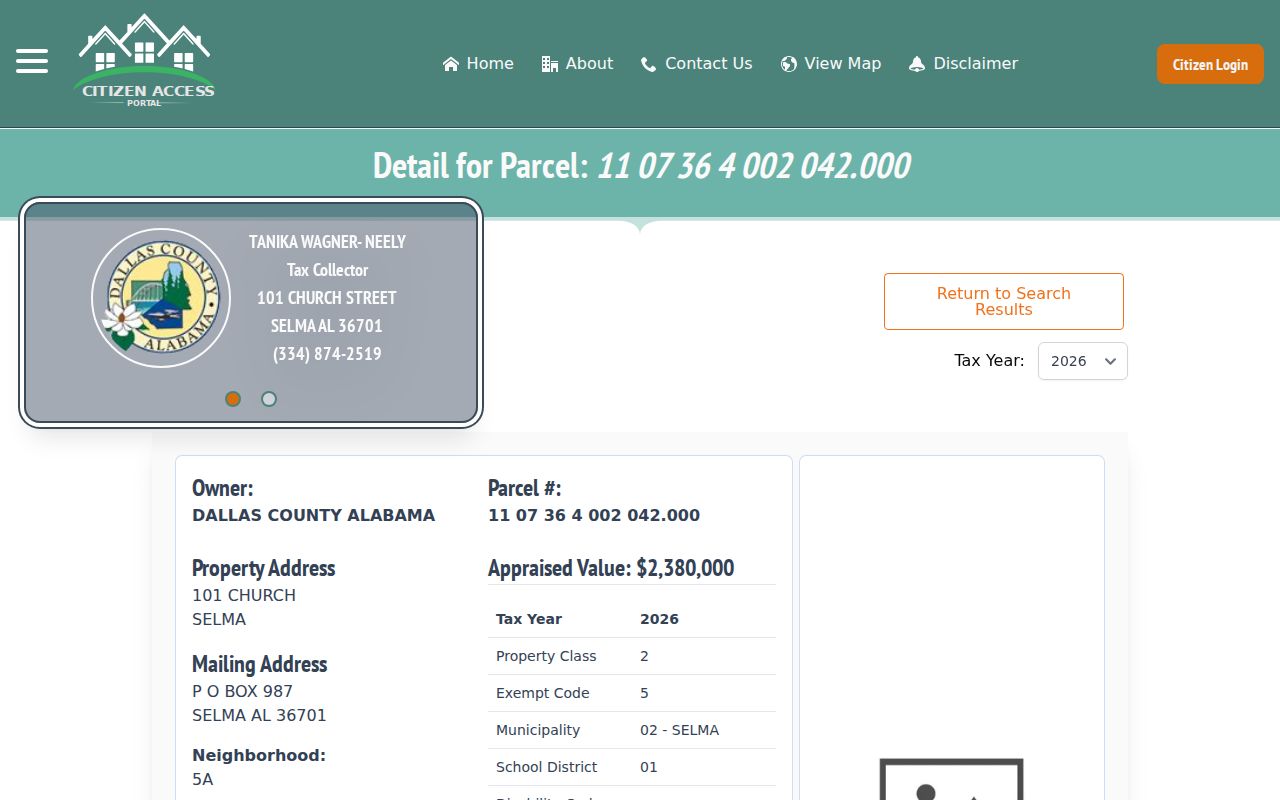
The sample earns its keep by revealing which neighboring fields confirm identity. Borrowing its owner name or values for a different parcel would corrupt your property search.
Account for Dallas County's October 1 Roll
Alabama bills property taxes in arrears. Dallas County assessment and collection material explains the timing. The tax bill goes to the owner of record on October 1 of the prior year. That timing matters more than most people expect. A lookup can return a perfectly valid current owner. It can still be stale for a sale that just closed. The record year you select is part of the answer. It is not a display detail to skim past.
CaptureCAMA offers search years 2020 through 2026. Choosing an earlier year answers a deliberate question: who appeared on that year's tax roll. It will not reconstruct every title transfer between those years. So pick the year that matches what you actually need to know about the Dallas County property records.
Verify Whether a New Deed Reached CAMA
The Dallas GIS Deed Status Report explains the handoff from deed to tax roll. Deeds received before Thursday noon appear online the following Monday. Each month's second week, prior-month change forms are printed and sent to the county for CAMA entry.
Useful timing clue. Weekly deed posting and monthly change-form transmission explain why the latest deed and current owner field can temporarily disagree. Dallas County does not publish a guaranteed day count for the owner update.
Timing rules differ by season, so read carefully. The report assigns October–December deeds to a tax year two calendar years ahead, while deeds from other months map one year ahead. Before deciding one source is wrong, compare the recording date, the tax year, and the parcel identity side by side.
Confirm the Dallas County Current Owner
- Open CaptureCAMA and note Owner, record year, parcel, key, situs and mailing fields.
- Read the deed reference and legal description from the same card.
- Use the Recording Office terminal or a targeted book/page request to check the latest deed.
- If an entity appears, use Alabama Secretary of State records to clarify entity identity without treating an agent as the landowner.
- Owner of record
- The party named on the active public roll.
- Vesting
- The deed language describing how title is held.
- Registered agent
- A designated entity contact, not automatically an owner.
Verify an Entity or Estate Owner
The Alabama Government Records Inquiry System covers business records for the state. It searches entity names, entity numbers, officers, agents, incorporators, and registrations. Match the exact spelling from the owner field and the deed. Similar business names are not interchangeable.
Trusts and estates need the deed itself. Look for representative capacity in the instrument. An administrator's or executor's deed may be the operative conveyance. Dallas County Probate wills and estate files can add context. The recorded deed remains the bridge back to the parcel number.
Municipal and Legal Identity Checks
The sample card shows municipality SELMA with section-township-range S36 T17N R10E. An older rural card reads differently: COUNTY DIST 37 and S5 T14N R08E. These fields keep same-name owners apart. They also keep similarly named roads from blurring together in Dallas County property records.
A postal city or ZIP only tells you where mail goes. Selma, Valley Grande and Orrville never replace Dallas County. Dallas County remains the keeper of deeds and assessment ownership. When city limits actually matter, compare the parcel map against the legal description instead of trusting the mailing city.
Reconcile Two Current-Owner Answers
Two systems rarely disagree for long. Most conflicts between a CAMA card, GIS card and deed come down to timing or mistaken identity. It is not failure. Start by confirming all three records describe the same land. Match the parcel or key and account number, legal description, municipality, acreage, subdivision and section-township-range. Current and legacy parcel formats look different, so deed book/page works as a spare crosswalk.
Dates explain many gaps. Line up each record by event date, recording date, report posting and tax year. A deed arriving after the Thursday-noon cutoff may miss Monday's online posting. The CAMA change form that follows only updates on a monthly cycle. A correction deed, release or mortgage can also be newer. That does not alter who owns the parcel now. Read the instrument type and granting language before drawing conclusions.
Small name differences deserve care. Initials, ampersands, trustee labels and entity suffixes all carry meaning. Keep each record's exact spelling, and never quietly merge people or organizations with similar names. If legal descriptions or vesting still clash, ask Recording staff for the most recent conveyance tied to the known book/page. Seek title assistance before any consequential decision.
Document a Dallas County Current-Owner Check
A solid note pays off later. Record the date searched, the CAMA record year, the exact owner field, situs and mailing addresses, parcel and key numbers, municipality, legal-description shorthand and deed reference. If you print or save a property card, note its URL and date. Portal content and active tax years shift over time.
For Recording Office follow-up, capture the instrument type, book/page, parties and approximate recording date. Phone verification goes nowhere without a book/page. So a precise note beats a general owner-name question every time. Depending on the record and office procedure, copy requests may be handled by email or mail.
Check Current Owners Through Every Route
CaptureCAMA is quick, yet other routes work too. The Tax Assessor's office sits at 101 Church Street in Selma, open weekdays from 8:30 a.m. to 4:30 p.m., at 334-874-2520; Mapping and Appraisal answers at 334-874-2535. Bring the parcel or key number when you call. The situs, owner spelling and record year also help a phone or counter inquiry go smoothly.
The Probate Recording Office, at 105 Lauderdale Street, offers computer stations so the public can search records directly. Have a book and page reference already? Staff will confirm limited details by phone at 334-877-0625. Copies may come by email, through recording@dallascounty-al.org, or by regular mail, depending on the record and the request. Check the official fee schedule before ordering anything.
When no portal or office channel turns up a public writing, Alabama Code §36-12-40 grants a right to inspect and copy public writings, subject to exceptions. Keep the request narrow. Name the record series, the instrument, the parties, the approximate date and the parcel. Do not ask staff to decide legal ownership or perform a title examination.
Contact a Dallas County Current Owner Responsibly
The tax roll's mailing address is the official route for property tax correspondence in Dallas County. It can support a legitimate letter about a purchase, an easement, a boundary, or an estate matter. A different mailing address proves nothing about where the owner of record lives. Property records do not name every person at the situs. Keep expectations realistic there.
Dallas County property search covers the deeper portal modes. For the address-first method, see who owns this property. To trace ownership backward, use former owners.
Before acting on a current-owner conclusion, run the same check by parcel number. Do not rely on street address alone. Watch for a blank physical address, a different mailing city, an entity suffix, or a representative title. Any of those details can explain an odd result. They also keep a lawful contact letter pointed at the public tax-mailing destination. That destination beats an assumed residence.
For a consequential transaction, get the actual deed copy and a professional title review. The public roll is a practical lead to the current owner. It is not a guarantee of every legal interest.
Lawful use. Use current-owner information only for legitimate property research and correspondence. Never use it to stalk, harass, intimidate, or harm a person.