
What Dallas County Property Tax Records Measure
The Dallas County Citizen Access portal puts assessment and collection data in one place. Two offices still stand behind it. The Tax Assessor locates taxable property and names the roll owner. It also assigns class, exemption, and value. The Tax Collector handles the billing side: receipts, delinquency, and tax-sale administration.
| Field | What It Shows | Where |
|---|---|---|
| Market/appraised value | Estimated full value for the record year | Tax Assessor / Appraisal |
| Assessment class | Percentage category applied to appraised value | Tax Assessor |
| Assessed value | Appraised value multiplied by classification | Tax Assessor |
| Exemption | Coded relief affecting taxable value or tax | Tax Assessor |
| Gross, exempt, and net tax | Charge before relief, relief amount, final charge | CaptureCAMA / Collector |
| Paid, due, receipt, delinquency | Collection status and transaction clues | Tax Collector |
Alabama's formula is simple. Appraised value multiplied by the classification ratio yields assessed value. Class I is 30%, Class II is 20%, and qualifying Class III property is 10%. Neither figure equals a sale price. So treat them as tax measures only.
Read the 101 Church Tax Example Carefully
Consider the 2026 parcel card for 101 Church. It shows a market and appraised value of $2,380,000. The assessed value is $476,000, exactly the 20% Class II ratio. Exemption code 5 produces a $27,370 gross tax. A matching $27,370 exempt tax follows. The net tax is zero. The owner of record is Dallas County Alabama itself. This government parcel is a field demonstration rather than a residential comparable. The official CaptureCAMA detail displays the same figures.
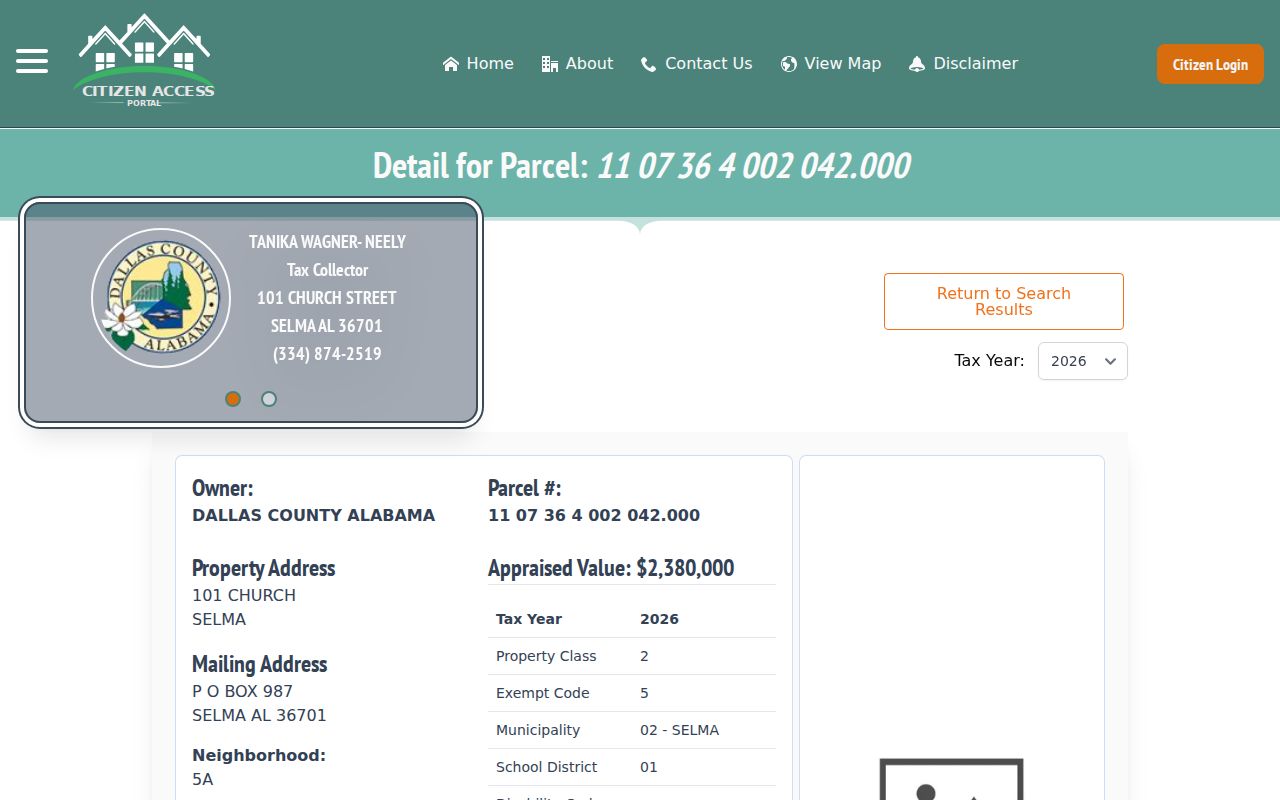
Separate value and exemption lines explain why quoting only the largest number can misstate a parcel's taxable position.
Apply Alabama Classification Before Millage
Class III covers agricultural and forest land plus owner-occupied single-family residences that meet the governing requirements. Class II is everything not otherwise classified. Class I covers utilities. The Alabama Department of Revenue assessment guide spells out the statewide formula.
Tax-record vocabulary
- Appraised value
- Fair-market-value estimate used before classification.
- Assessed value
- The class-adjusted value used in the tax calculation.
- Millage
- A rate applied to assessed value, commonly expressed per thousand.
- Tax lien
- A claim arising from unpaid tax, not an immediate fee-simple purchase of the land.
The portal's millage table lists totals of 34.1 for county and Valley Grande, 42.0 for Orrville, and 57.5 for Selma. Confirm your municipality and the current year before applying any row. Keep the class code, exemption, and record year beside each copied value so the assessed figure checks against the correct statutory ratio.
Look Up a Dallas County Tax Bill
Search real property by address, owner, parcel, key, or mailing address and pick the record year. The portal offers 2020 through 2026 year choices. Those selections are not the same as the site's active tax-year metadata, so match them deliberately.
- Match owner, situs, municipality, and parcel before opening the card.
- Read land, improvement, appraised, assessed, taxable, gross, exempt, and net fields separately.
- Check total due, paid status, receipt, open-lien count, and back-tax indicators.
- Verify questions with the Tax Collector at 334-874-2519 or Tax Assessor at 334-874-2520.
Taxes are due October 1 and turn delinquent after December 31. County guidance puts interest at 1% per month once that happens. The collector can confirm a parcel ID and amount, mail a paid receipt on request, and send assessment errors back to the assessing office.
Dallas Tax Bills May Show Prior Owners
Alabama's tax year runs October 1 through September 30, with taxes paid in arrears. The bill due October 1 names the owner of record from October 1 of the prior year. Dallas County explains this. So a January buyer may receive a bill in the former owner's name. That lag is normal. An "In Care" notice reflects the same timing. The Tax Collector does not prorate taxes between buyer and seller. Closing professionals handle that contractually. A bill-name lag is no substitute for checking the newly recorded deed.
Claim Dallas County Property Tax Relief
The Alabama homestead guide describes the H-1 through H-4 categories. Applications go through the local office. Age, income, disability, state, county, and school relief all differ by category, so read the current table instead of generalizing from an exemption code. For qualifying Class III farm, pasture, or timber land, state statutes describe a current-use request window running October 1 through January 1. A new owner must reapply after a sale. Dallas portal wording says request by December 31. Confirm the operative deadline with the assessor before filing.
Separate Delinquency, Tax-Lien Sale, and Redemption
The delinquent-property search accepts owner, address, or parcel clues. One notice announced a May 12, 2026 lien sale, but its hyperlink pointed to an Autauga test destination and that date has passed. Treat such notices as archived. The Dallas portal and the Tax Collector hold the next current sale information.
Tax interest is not immediate ownership. Dallas County's notice describes a lien-sale purchase as tax interest only, with redemption and later deed procedures still governing.
Contest a Dallas County Assessment on Time
Start with the notice, the parcel card, classification, exemption, and property facts. Ask the assessor to explain the record. Then submit a written objection within the notice's applicable period. Ala. Code §40-7-25 supplies the valuation-notice framework and its 30-calendar-day objection window. If the matter moves past the Board of Equalization, §40-3-25 describes a 30-day appeal after notice. Filings go to the BOE secretary and circuit clerk. Tax-payment or bond conditions also apply. The portal's BOE search is disabled, so follow the current notice and office instructions instead.
Appeal window. Preserve the notice date and act within the stated 30-day framework; confirm forms, filing points, and current requirements with Dallas County before relying on a portal route.
Good evidence targets the assessment itself. Classification, acreage, condition, exemptions, and neighborhood grouping are the fields that matter. The Appraisal Department tracks yearly changes from building permits, septic permits, recent sales, and taxpayer requests. Values carry an October 1 effective date and are maintained or reestablished within a four-year period.
Dallas County treats foreclosures and short sales as involving undue stimulus rather than ordinary open-market evidence. Instead of presenting one sale price alone, explain the differences in condition, use, land area, and transaction circumstances. Photographs, surveys, permits, and repair documentation can address the parcel record directly.
Alabama also caps annual assessed-value increases at no more than 7% for Class II and III property, subject to statutory exceptions. Consult the Act 2024-344 guidance and confirm how it applies to the particular tax year.
Escrow owners should take one extra step. Compare the county balance with the mortgage company's payment record and verify the parcel ID. Courtesy notices are usually mailed. A missing notice does not erase the obligation. Refunds go to the original payer, and assessment errors pass through the assessor before any collector adjustment.
At 101 Church Street, split your questions by office. Assessment, class, ownership, and exemption issues go to the Tax Assessor. Bill status, receipts, interest, and delinquency go to the Tax Collector. Bring parcel and account identifiers rather than relying only on a name.
Save dated copies of the parcel card, bill, and assessment notice. Another record year can show different ownership, values, exemptions, or payment status, and active tax-year metadata is not interchangeable with the year printed on a specific card.
Keep land value and improvement value separate when comparing records. A change in one component may point to different evidence than a change in the other, whether an acreage correction, new construction, demolition, condition, or permit information. Ask the appraisal staff which field changed and which source supported it.
Current-use treatment is never automatic just because land looks agricultural or wooded on a map. The owner must satisfy the applicable Class III rules and request current-use valuation on time. A purchaser must reapply after a sale. Keep the application, the decision, property-use evidence, and tax-year information together so a later card can be compared against the filed request.
Millage depends on geography. Match the portal's county, Selma, Orrville, and Valley Grande rows to the parcel's actual municipality and current tax year, not simply its mailing city. A ZIP label may cross municipal boundaries. If the municipality code and postal address conflict, verify the parcel record and Mapping information before choosing a rate. Save the selected millage row with the bill or calculation, because that small record shows which local rate was used and keeps a later postal-address change from being mistaken for a change in tax district.
Delinquent research has its own sequence. First confirm the correct parcel and balance with the collector. Next identify the notice, sale date, lien interest, and redemption status. Finally, inspect deeds and statutory steps before drawing any ownership conclusion. Dallas County's notice emphasizes that a lien-sale interest is not the property itself, and an expired notice is not a schedule for a future sale.